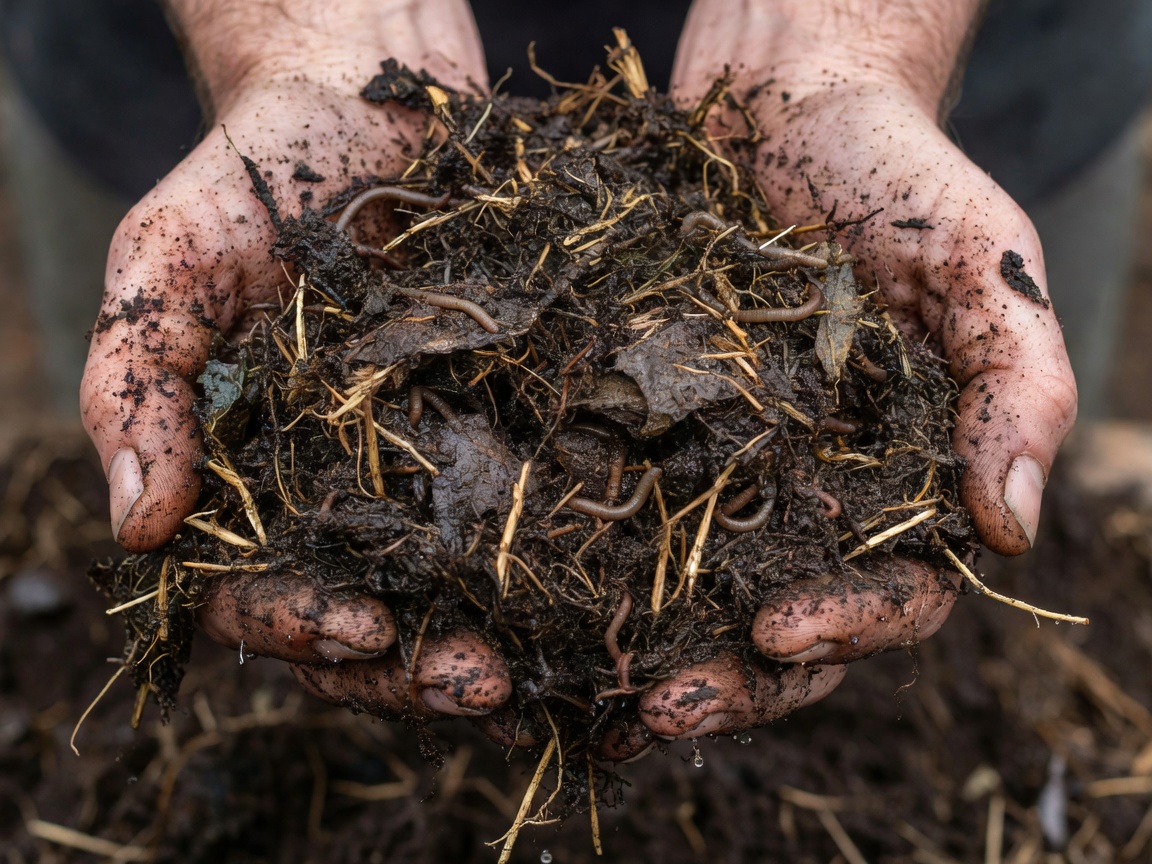
Bagged fertiliser feeds this year's crop and leaves the ground poorer. Compost and mulch feed the life in the soil, and that life feeds every crop after. This is the loop everything else hangs on.
The Soil Loop at a Glance
The loop in one line
If it grew here, it can rot here
Peelings, spent crops, weeds without seed heads, grass, leaves, cardboard and coffee grounds all go back on the plot. What comes out of the bin in autumn is what goes on the beds in winter. You stop buying compost and start making it.
Add as you go, leave it a year. Easy, forgiving, but weed seeds survive.
Method
Hot heap
Build a cubic metre in one go, turn it, and it can reach 55–65°C, which kills most weed seeds.
Why soil comes first
Healthy soil is a sponge, a larder and a workforce in one. Organic matter holds water through dry spells, releases nutrients slowly as microbes break it down, and gives worms, fungi and bacteria something to eat. Feed that system and it feeds your plants. Skip it and you're stuck buying fertiliser, watering more and fighting compaction every spring.
The closed-loop version is simple: nothing organic leaves the garden in a council bin if it can rot on site. Sir Albert Howard laid this out in An Agricultural Testament in 1940, based on the layered Indore method he developed in India. Eighty-odd years later, it still works on a back garden.
Build a heap that works
Most failed heaps are either too wet and slimy or too dry and dead. Aim for roughly equal volumes of "greens" (fresh, wet, nitrogen-rich: peelings, grass, green weeds) and "browns" (dry, carbon-rich: cardboard, straw, autumn leaves, shredded stems). Garden Organic gives the same rule of thumb.
Size: at least a cubic metre if you want heat. Smaller bins still compost, just slowly.
Moisture: like a wrung-out sponge. Too wet, add cardboard. Too dry, add greens or water.
Air: turn it once or twice, or poke holes with a fork. Smell means it's airless.
Two bays: one filling, one finishing. Three if you have the space.
Leave out cooked meat, fish and dairy in an open heap; they draw rats. Perennial weed roots like bindweed and couch grass can drown first in a lidded bucket of water for a few weeks, then go on the heap as sludge.
No dig, less work
Charles Dowding has run side-by-side dig and no-dig beds at Homeacres in Somerset for years, and the no-dig beds hold their own or better on yield with far less weeding. The method: lay cardboard over grass or weeds, cover with 10–15 cm of compost, plant straight in. Each year, top up with 3–5 cm. Digging breaks the fungal threads that move water and nutrients, and it lifts buried weed seed into the light. Don't do it unless you have to.
Go peat-free
Peat bogs store vast amounts of carbon and take thousands of years to form. Digging them up for seed trays makes no sense. For sowing, use sieved leaf mould mixed with sieved garden compost. For potting on, buy a peat-free mix; the RHS has trialled them and the better brands now perform well. Water peat-free mixes little and often at first, because the surface can look dry while the middle stays wet.
Mulch, compared
Mulch is a lid on the soil. It cuts evaporation, suppresses weeds and feeds the soil life as it breaks down. Match the mulch to the job:
Common garden mulches
Mulch
Best for
Breaks down
Feeds soil
Watch out
Garden compost
Veg beds, no-dig
3–6 months
High
Weed seeds if the heap stayed cool
Leaf mould
Woodland plants, seed mixes
6–12 months
Moderate, great structure
Takes 1–2 years to make
Wood chip
Paths, fruit trees, shrubs
1–3 years
Low at first, builds fungi
Keep off seedlings; don't dig it in
Straw
Strawberries, squash, potatoes
6–12 months
Low
Check it's free of aminopyralid herbicide
Cardboard
Clearing grass and weeds
2–4 months
Low
Remove tape and glossy print
Grass clippings
Thin layers round crops
Weeks
Moderate, nitrogen-rich
Thick layers go slimy; never from treated lawns
Seasonal tasks
Top up beds with 3–5 cm of compost before planting.
Turn the heap once the weather warms; start a fresh bay.
Dig in nothing. Rake the surface fine for direct sowing.
Mulch after a good rain, never onto dry soil.
Keep the heap damp; summer heaps dry out fast.
Compost spent crops straight away; chop them small.
Collect leaves into wire cages or punctured bags.
Sow green manure such as field beans or winter rye on empty beds.
Empty finished compost and spread it before the ground gets wet.
Lid or cover the heap against waterlogging.
Keep off wet soil; use boards if you must walk on beds.
Plan next year's beds around how much compost you'll have.